Are you an engineer ready to build real AI systems?
Join the Engineer's AI Accelerator | Built by an Engineer, for Engineers Who Ship
Join the Engineer's AI Accelerator | Built by an Engineer, for Engineers Who Ship
I now know I can take an idea from scratch to a production system: pipeline, evaluation, caching, self-correction, deployment. I ended up with a real, working product, and that confidence is what I'll take directly into my next project.
This course is more than worth it. I learnt more in 2 weeks than in the prior 6 months, and I am not kidding. The instructor is very patient and understanding.
The spec and system-design thinking here is the kind of rigor I've seen senior engineers apply in design reviews at Amazon and PayPal. Take the course, but be prepared for the intensity.
Spend time and money on this course if you want to really learn, and not just have slideware understanding.
It's been a week and I am already recommending it. This course content is like a precious gem, synthesising many important concepts, very well structured.
I now know I can take an idea from scratch to a production system: pipeline, evaluation, caching, self-correction, deployment. I ended up with a real, working product, and that confidence is what I'll take directly into my next project.
This course is more than worth it. I learnt more in 2 weeks than in the prior 6 months, and I am not kidding. The instructor is very patient and understanding.
The spec and system-design thinking here is the kind of rigor I've seen senior engineers apply in design reviews at Amazon and PayPal. Take the course, but be prepared for the intensity.
Spend time and money on this course if you want to really learn, and not just have slideware understanding.
It's been a week and I am already recommending it. This course content is like a precious gem, synthesising many important concepts, very well structured.
I now know I can take an idea from scratch to a production system: pipeline, evaluation, caching, self-correction, deployment. I ended up with a real, working product, and that confidence is what I'll take directly into my next project.
This course is more than worth it. I learnt more in 2 weeks than in the prior 6 months, and I am not kidding. The instructor is very patient and understanding.
The spec and system-design thinking here is the kind of rigor I've seen senior engineers apply in design reviews at Amazon and PayPal. Take the course, but be prepared for the intensity.
Spend time and money on this course if you want to really learn, and not just have slideware understanding.
It's been a week and I am already recommending it. This course content is like a precious gem, synthesising many important concepts, very well structured.
It's helping me find use cases that genuinely benefit the team and client, instead of retrofitting AI as a buzzword, and making sure we approach it with proper evaluation and tracing.
This is a wonderful course for a beginner, intermediate or even expert. At every step, I learn multiple strategies, get the chance to experiment each of them on my data and see and evaluate the results myself. That is so empowering. I will highly recommend this course to any of my friends or colleagues.
This course really changed how I think about building AI systems. The biggest shift for me was learning to trust evaluation over instinct. Really grateful for this course.
Joining your Engineer's RAG Accelerator program is one of the best decisions I made in the last 6 months to upskill myself in AI. The structured approach, the depth in the content, a detailed explanation of every concept, clear cut instructions under every module. You are awesome!!
It's helping me find use cases that genuinely benefit the team and client, instead of retrofitting AI as a buzzword, and making sure we approach it with proper evaluation and tracing.
This is a wonderful course for a beginner, intermediate or even expert. At every step, I learn multiple strategies, get the chance to experiment each of them on my data and see and evaluate the results myself. That is so empowering. I will highly recommend this course to any of my friends or colleagues.
This course really changed how I think about building AI systems. The biggest shift for me was learning to trust evaluation over instinct. Really grateful for this course.
Joining your Engineer's RAG Accelerator program is one of the best decisions I made in the last 6 months to upskill myself in AI. The structured approach, the depth in the content, a detailed explanation of every concept, clear cut instructions under every module. You are awesome!!
It's helping me find use cases that genuinely benefit the team and client, instead of retrofitting AI as a buzzword, and making sure we approach it with proper evaluation and tracing.
This is a wonderful course for a beginner, intermediate or even expert. At every step, I learn multiple strategies, get the chance to experiment each of them on my data and see and evaluate the results myself. That is so empowering. I will highly recommend this course to any of my friends or colleagues.
This course really changed how I think about building AI systems. The biggest shift for me was learning to trust evaluation over instinct. Really grateful for this course.
Joining your Engineer's RAG Accelerator program is one of the best decisions I made in the last 6 months to upskill myself in AI. The structured approach, the depth in the content, a detailed explanation of every concept, clear cut instructions under every module. You are awesome!!
I found the content extremely practical and genuinely useful, especially for building real-world AI applications. I'd highly recommend it to anyone looking to learn and build production-grade AI systems.
This course has been the best investment of time and effort for me. I loved your teaching methodology and curriculum. I never thought I could be an engineer again after moving over to product mgmt for several years. Thanks for putting the fire back in me!
The best reference I've ever seen on RAG.
It's forcing me to think differently. When I apply it in the assignment, the aha is there.
I found the content extremely practical and genuinely useful, especially for building real-world AI applications. I'd highly recommend it to anyone looking to learn and build production-grade AI systems.
This course has been the best investment of time and effort for me. I loved your teaching methodology and curriculum. I never thought I could be an engineer again after moving over to product mgmt for several years. Thanks for putting the fire back in me!
The best reference I've ever seen on RAG.
It's forcing me to think differently. When I apply it in the assignment, the aha is there.
I found the content extremely practical and genuinely useful, especially for building real-world AI applications. I'd highly recommend it to anyone looking to learn and build production-grade AI systems.
This course has been the best investment of time and effort for me. I loved your teaching methodology and curriculum. I never thought I could be an engineer again after moving over to product mgmt for several years. Thanks for putting the fire back in me!
The best reference I've ever seen on RAG.
It's forcing me to think differently. When I apply it in the assignment, the aha is there.
By the end, you walk away with the production AI skills employers are actively hiring for
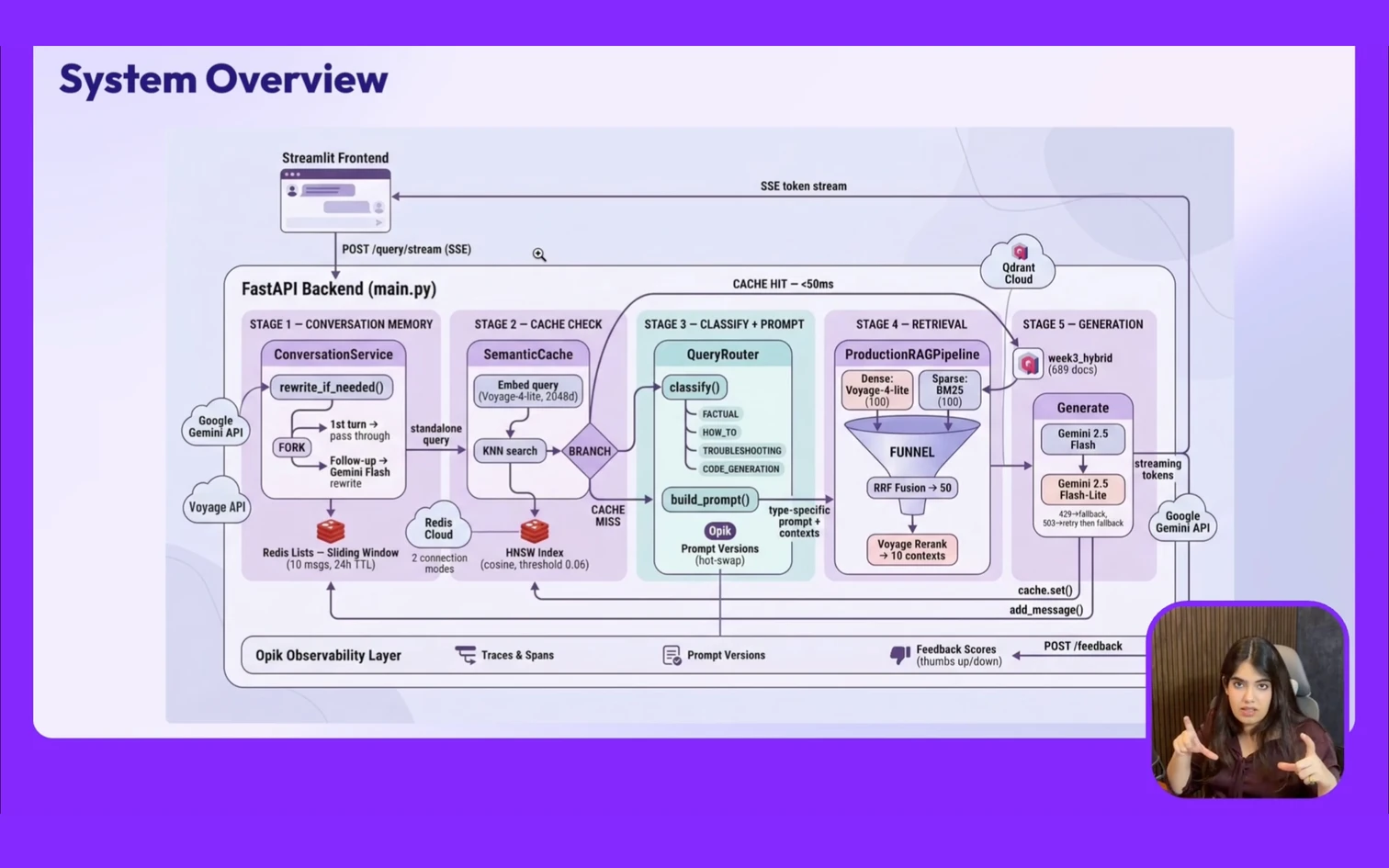
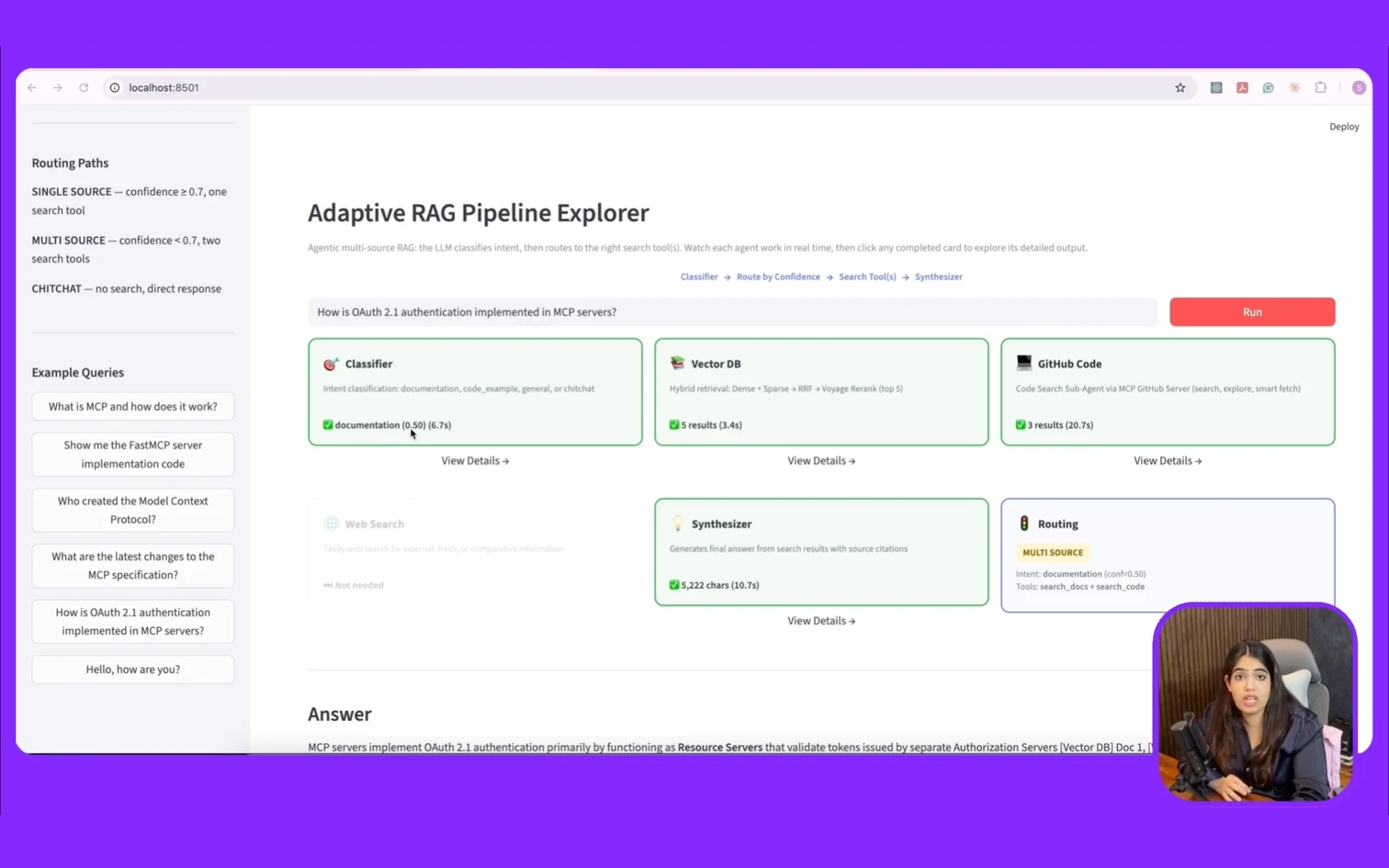
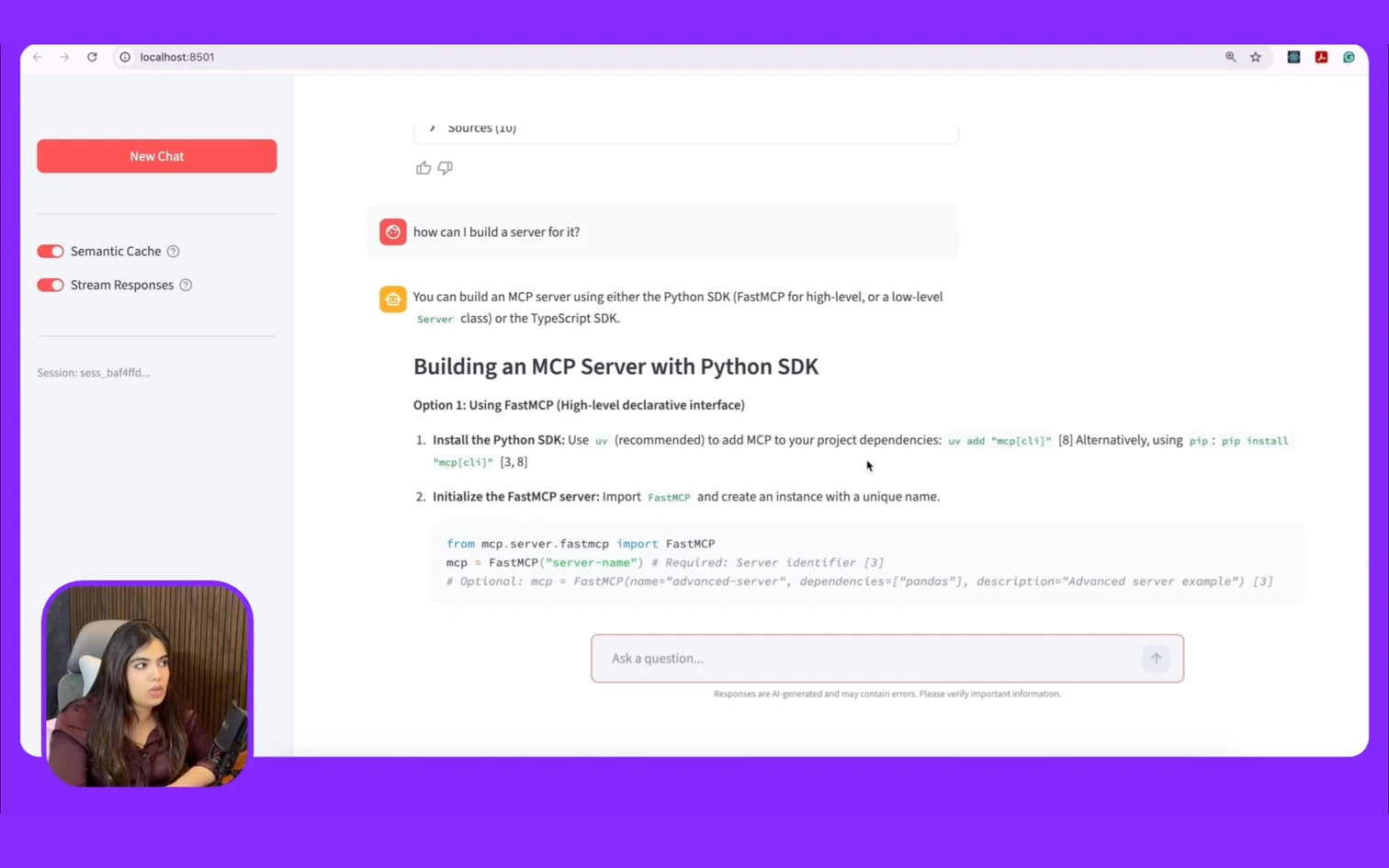
Scope, architect, and build AI-powered applications from first principles. Cost, accuracy, and latency tradeoffs. Semantic caching, query routing, conversation memory, streaming APIs, observability, containerized deployment. Every layer built and evaluated on your own data.
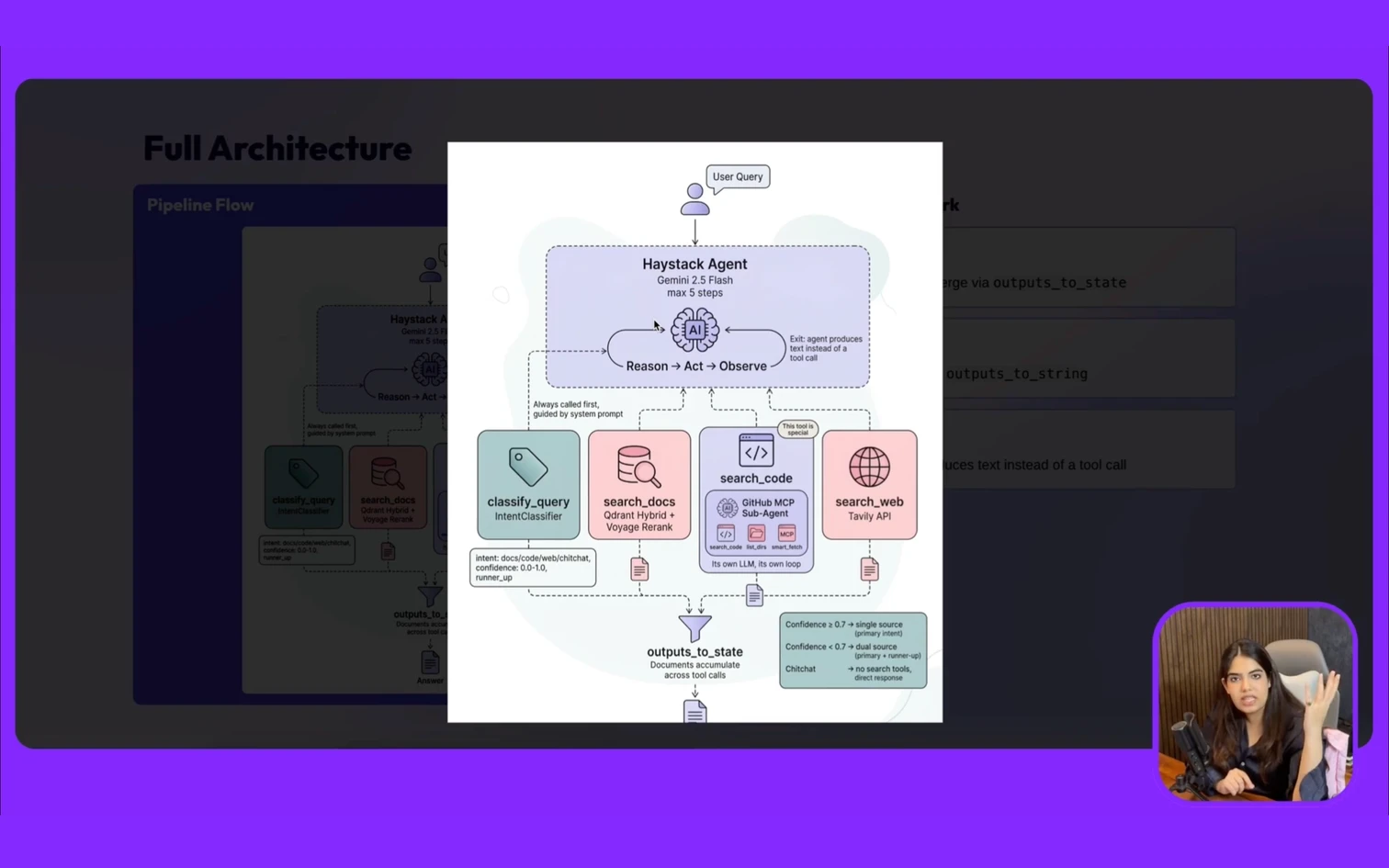
From API calls to prompt chaining, tool use, MCP, self-correcting systems, adaptive routing, agents, and multi-agent orchestration. Each one built and evaluated.
Golden dataset curation, LLM-as-a-judge pipelines, semantic metrics (Precision@k, MRR, NDCG), synthetic test generation. The measurement layer that separates a demo from a system you can actually trust.
Built on your own data, for your own use case. Complete with a demo video, architecture documentation, iteration log, and evaluation results. Ready to show employers or clients.
100+ lessons. 45+ hours of hands-on content. Structured to take you from foundations to production.
Build a working RAG pipeline that answers questions from real documentation
Framework: RAG Project Scoping Framework
You build
Interactive Q&A system on MCP documentation
Test 7 chunking strategies on your data and find the winner
Framework: Chunking Decision Framework
You build
Ranked chunking strategy backed by your own evaluation evidence
Optimize retrieval accuracy from 70% to 90%+
Framework: Retrieval Strategy Selection Framework
You build
Evidence-based retrieval strategy with 4 techniques evaluated head-to-head
Build your own evaluation system with golden datasets
Framework: RAG Evaluation Strategy Framework
You build
Golden dataset + multi-method evaluation framework
Deploy a production chatbot with caching, memory, and observability
Framework: Production RAG Architecture
You build
Deployed production chatbot serving real requests
Build a self-correcting RAG agent with adaptive routing
Framework: Intelligence Spectrum Framework
You build
Self-correcting CRAG system + adaptive multi-tool agent
Scale a RAG system from one tenant to hundreds, and thousands of documents to millions.
Framework: AI System Design Framework
You build
A production-scale architecture for your own system, interview-ready
Your capstone builds across every part, on your own data. Graded, and portfolio-ready.
The Investment
AI engineering roles pay ~67% more than traditional software, and demand is up 143% year over year.
Here's what you're getting access to.
6 parts, 19 modules, 100+ lessons
RAGAS, DeepEval, LLM-as-Judge
Maturity curve, context engineering, and more
Instant answers on your code and the content
On your own data, graded, with a certificate
Every update, plus the community
Self-Paced
The complete Accelerator, on your schedule.
Special Launch Price
Join now to get exclusive access to the launch price.
Cohort
A 10-week, high-accountability program with Shivani.
Early bird
Everything in Self-Paced, plus:
Join now for exclusive early-bird access.
PS: After you sign up, we'll send you a verification email. Please confirm it to secure your place on the waitlist, and check your spam folder if it's not in your inbox.
Check your inbox for a verification email and click the link to confirm your spot.
PS: it may land under Promotions or Spam, so move it to your Primary inbox so you don't miss what's next.
Meet Your Instructor

Shivani Virdi
AI Engineer. Founder, NeoSage.
12.5M+
Engineers reached
90K+
Community
100+
Engineers trained
Shivani Virdi built production systems at Microsoft, AWS, and Adobe for products serving millions of users. Her work spanned backend infrastructure, distributed systems, and applied AI across enterprise-scale products.
She quit Microsoft to build NeoSage, an AI engineering education brand that 90,000+ engineers follow today. At Microsoft, she designed a production RAG workshop for engineers, PMs, and leadership across her sub-organization. That workshop was 5% of what this course covers. She then built and delivered the full course to 100+ engineers from Microsoft, Amazon, Apple, Adobe, Shopify, Citi, Lockheed Martin, Autodesk and more.
Got Questions?
Everything you need to know before joining.
About the Course
This course teaches you to build production AI systems end-to-end.
You'll learn the full AI engineering stack: LLM fundamentals, data ingestion, chunking strategies, embedding models, vector databases, hybrid search, reranking, evaluation frameworks (RAGAS, DeepEval, LLM-as-Judge), semantic caching, AI systems API design, AI observability and trace management, Docker deployment, and agentic systems. RAG is one of the core skills at the center of it, and building it well is what pulls the whole stack together.
These are the exact skills companies are hiring for right now. Every part has a hands-on project on your own data, and you finish by building and shipping a full capstone that earns you a certificate. The two formats differ in how you're graded: in the cohort, Shivani reviews your work personally at every milestone; in the self-paced track, an AI evaluator grades your capstone and gives you detailed feedback.
RAG (Retrieval Augmented Generation) is how you make AI work with your own data.
LLMs on their own can't access your private documents, internal databases, or real-time information. They hallucinate when they don't know. RAG solves this by retrieving relevant information from your data sources and feeding it to the model at the time of the query. No retraining needed.
This is the pattern behind every production AI application you use today: customer support bots, code assistants, enterprise knowledge systems, copilots. If you're building AI that needs to be accurate and grounded in real data, you're building RAG.
For a deeper dive, read our guide: The Engineer's Guide to RAG.
RAG is to AI engineering what CRUD is to web development. It's the foundational pattern that production AI applications are built on.
More than that, building RAG the right way requires mastering the full set of skills the industry demands: AI system design, retrieval and ranking architectures, evaluation methodology, embedding and vector search, LLM orchestration, AI observability, and production deployment.
These are not RAG-specific skills. They are the core competencies of a production AI engineer. RAG is simply the best vehicle to learn all of them together.
Most courses teach you concepts and give you clean demos. This course makes you build, evaluate, and ship. Four things set it apart.
First, you don't just learn techniques, you build decision frameworks. Every module gives you a methodology for choosing the right approach for your data, not a one-size-fits-all tutorial.
Second, evaluation is a first-class citizen. An entire section of the course is devoted to evaluation: building golden datasets, LLM-as-Judge pipelines, and triangulating across independent evaluation methods. This is where 60-80% of real production work happens, and almost no course covers it seriously.
Third, every project is on your own data, your own use case. Not a toy dataset we hand you.
Fourth, your capstone is graded with detailed feedback. If you're in the cohort, Shivani judges your submissions personally at every milestone. It's the kind of project engineers put straight into interviews and stakeholder conversations, not a throwaway exercise.
Is This For Me?
This course is built for software engineers with production experience who want to build AI engineering skills. You should be comfortable writing and debugging code. The course uses Python, but most engineers can cross-apply their coding skills from any language. No AI or ML experience is needed.
More than 100 engineers have taken it, and it's a senior room: nearly 80% come in with 5+ years of experience, and the majority with more than a decade. Titles have ranged from Senior and Staff Engineer to Principal Engineer, Enterprise Architect, Director of Engineering, VP, and CTO, from companies like Microsoft, Amazon, Apple, Adobe, Shopify, Citi, IBM, Docusign, Oracle, JPMorgan Chase, Autodesk, Twitch and more.
Whether you're a backend engineer exploring AI, a tech lead evaluating AI adoption for your team, or a product engineer looking to build intelligent features, this course gives you the production-grade foundation to do it.
No. The course starts from first principles: how LLMs work under the hood, pre-training, tokenization, attention mechanisms, and post-training. You build up from there, module by module.
Nearly a third of students started as complete AI beginners. At the other end, engineers who had already built LLM-powered applications came for production-scale rigor: evaluation, system design, and the tradeoffs most tutorials skip. Both shipped the same capstone, because the course is built to serve the full spectrum.
The prerequisite is not AI knowledge. It's engineering maturity: the ability to read documentation, debug systems, and think about tradeoffs. If you've shipped production software, you have what it takes.
Self-Paced or Cohort?
It comes down to how you do your best work.
Go Self-Paced if you learn well on your own. You get the entire curriculum, the hands-on labs, the graded capstone, and your certificate, with lifetime access and every future update. You set the pace and you're comfortable unblocking yourself when you hit a wall. For a disciplined engineer who wants the material and the reps, it's everything you need.
Go Cohort if you want direct access, real accountability, and a room of peers. Everything in Self-Paced is included, and then the part you can't replicate alone is added on top:
• Direct and quick access to the Instructor. Stuck on your own retrieval architecture or evaluation setup at 11pm? Drop it in the dedicated cohort Discord channel for a quick resolution, and if you're still stuck, bring it to the live office hours and work through it with Shivani. You get expert eyes on your exact problem, and you move on the same day instead of losing a weekend to it.
• Accountability that gets you across the line. Ten weeks, real deadlines, and milestone work graded personally by your instructor. Most self-paced courses die half-finished in a backlog tab. This one ends with a system you've actually shipped.
• A room of 50 senior engineers building in parallel. You brainstorm, compare approaches on different data, and pressure-test your thinking against people at your level. Once you're the senior engineer on your own team, a peer group like that is hard to come by.
• Cohort exclusives. The cohort-only module, Designing & Operating AI Systems at Scale, plus seven live sessions and a private cohort Discord.
If you're self-directed and just want the knowledge, Self-Paced has you covered. If you want the feedback, the accountability, and a close-knit group of fellow professionals on the same journey as you, and you want to come out the other side having actually shipped, the Cohort is built for exactly that.
The cohort follows a hybrid learning framework: it combines the time freedom of self-paced learning with the high-touch experience of a live program. The core learning modules are pre-recorded, so you move through them on your own time each week, while the office hours run live.
What the 10 weeks add is structure and support around that content:
• A week-by-week schedule with deadlines, so you keep pace and actually finish instead of stalling out.
• Live office hours where you bring your blockers and questions and work through them in real time. Every session is recorded and shared, so a timezone clash never sets you back.
• Milestone submissions the instructor reviews and grades, with detailed feedback on your own system.
• A private cohort Discord that becomes the active, two-way channel between you, Shivani, and the rest of the cohort throughout the ten weeks.
Plan for roughly 10-14 hours a week. It's intensive, but because the teaching is recorded, you decide when those hours happen: evenings, weekends, lunch breaks. The only thing the schedule asks of you is that you hit the weekly milestones.
The next cohort is the September 2026 cohort. It runs for 10 weeks, starting in late September.
The cohort is capped at 50 seats to keep the experience high-touch for every student. Enrollment opens to the waitlist first, and the waitlist is the only way to get the early-bird price, which is limited to the first 10 seats. Joining the waitlist is free, with no payment and no commitment.
Prefer to start sooner, or on your own schedule? The Self-Paced track opens September 4, 2026.
Format & Logistics
You have lifetime access to all course materials, recordings, labs, and future updates.
The curriculum is designed to be revisited. Many students rewatch videos two or three times to fully internalize concepts before moving on.
Some deliberately slow down to prioritize depth of understanding over pace. The goal is mastery, not a deadline.
The course uses a production-grade, industry-standard stack: Haystack for orchestration, Qdrant for vector search, Gemini API and Voyage AI for LLM and embedding models, Redis for semantic caching, FastAPI for API design, Streamlit for prototyping, Opik for observability and tracing, and RAGAS and DeepEval for evaluation.
Every tool was chosen because production teams actually use it. But more importantly, the course teaches you the principles behind each layer: why you'd pick one vector database over another, when to use hybrid search vs dense retrieval, how to evaluate tradeoffs between latency, cost, and accuracy.
These mental models transfer to any stack your company uses, whether that's LangChain, LlamaIndex, Azure AI, or AWS Bedrock.
Yes, and many students do. If your company offers a learning and development budget, this course is a natural fit.
We give you everything you need to get it approved: a completion certificate, a detailed course outline, and a receipt or invoice, plus any other documentation your L&D or HR team asks for.
And the case is easy to make. The course maps directly to production AI engineering skills, one of the fastest-growing and most in-demand skill sets in the industry right now.
The industry is hiring production AI engineers at scale. The bottleneck isn't model capability, it's engineers who can build reliable systems around models.
This course gives you the exact skill set that's in demand: AI system design, retrieval architecture, evaluation methodology, LLM orchestration, observability, and production deployment. You also walk out with a portfolio-ready capstone built on real data, graded with detailed feedback.
These are a few of the real journeys past students have had after taking the Accelerator:
• An applied scientist who came in wanting production rigor and one portfolio project to show for it used exactly that to land a dedicated AI Engineer role abroad, with a significant raise.
• A complete AI beginner finished having shipped a working production system.
• A product leader who'd stepped away from hands-on engineering years ago got back to building.
• Others took their capstone into an internal pilot, or used it to lead their team's first AI initiative.
The skills and the evidence together give you both the vocabulary and the proof for any AI engineering conversation, whether it's an interview, a promotion case, or a team pitch.
We use analytics cookies to see how this page is used, so we can make it better. Read the Privacy Policy.

The Love on LinkedIn
Engineers trained across